


A reflection before Chapter 4
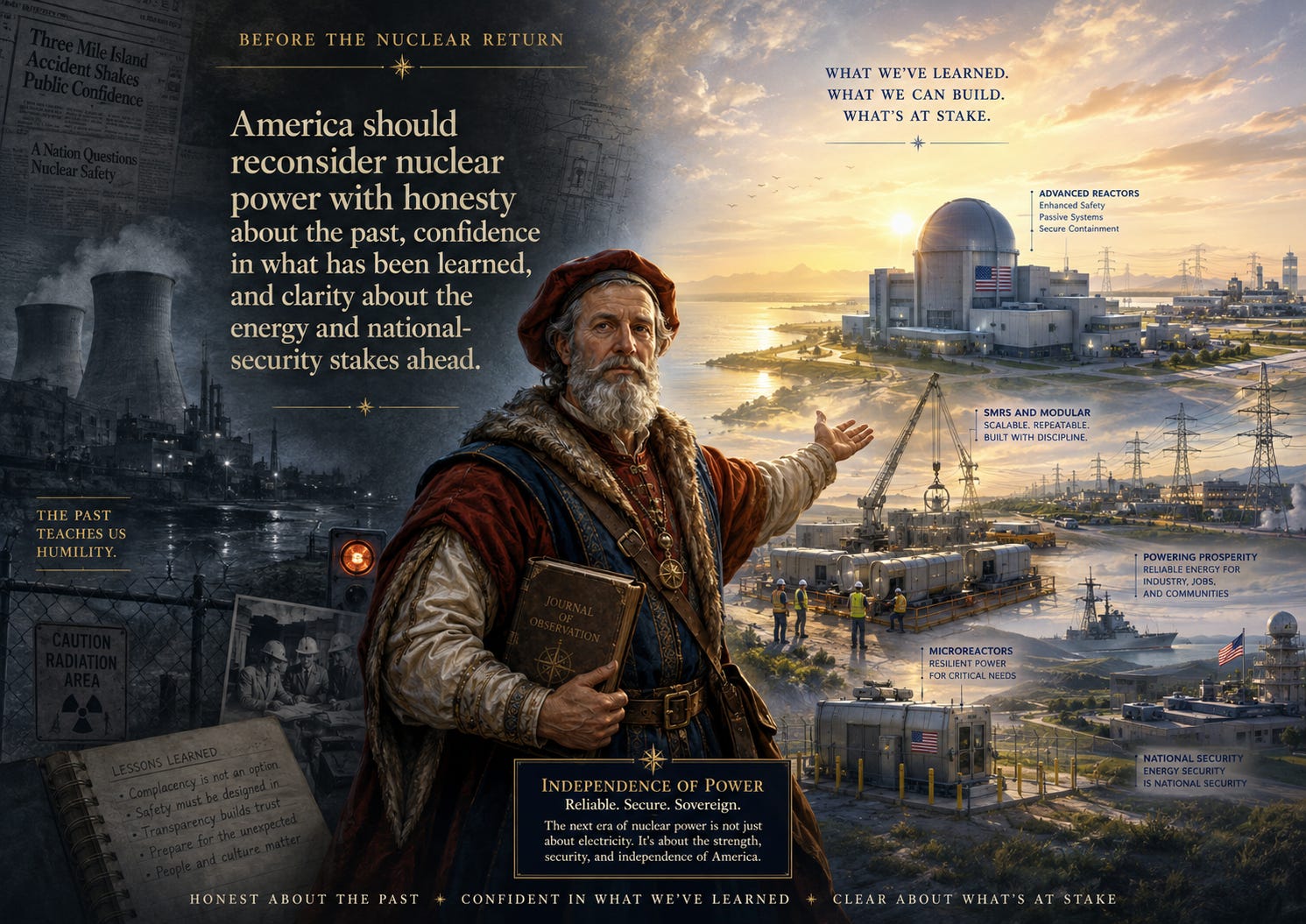
Before proceeding to the reactors, fuels, factories, workers, and institutions that will shape America’s nuclear return, we owe the reader a pause.
Nuclear power occupies a different place in the public imagination than nearly every other source of energy. People do not encounter it first through a discussion of capacity, land use, fuel security, industrial heat, or national resilience. They encounter it through names: Three Mile Island. Chernobyl. Fukushima.
Those names matter. They represent real accidents, damaged plants, displaced communities, human failures, institutional failures, and lessons purchased at great cost. A credible argument for nuclear energy cannot begin by pretending that these events did not occur or that public concern is irrational.
Why Pause Here
The first three chapters of this series established the condition of the American power system. Demand is rising. Dependable margins are tightening. Large new loads are arriving faster than generation, equipment, transmission, and regulatory institutions can respond. Rules can distribute scarcity, but rules cannot manufacture electricity. America must build power again.
Chapter 4 will turn to the nuclear family: the existing fleet, large conventional reactors, small modular reactors, microreactors, advanced designs, fuel, factories, suppliers, workers, and repeat orders. That discussion should be allowed to remain clear and constructive. It should not have to stop every few paragraphs to relitigate the entire cultural history of nuclear energy.
But readers deserve more than an assertion that nuclear power is necessary. They deserve a candid consideration of the fears, history, tradeoffs, environmental questions, and national responsibilities that accompany it. This interlude is therefore not Chapter 4. It is the ground on which Chapter 4 can stand.
The Incidents Must Be Remembered Accurately
Three Mile Island experienced a partial core meltdown in 1979 and remains the most serious accident in the history of American commercial nuclear power. The event exposed failures in equipment design, instrumentation, operator understanding, training, and communication. It also tested the plant’s containment. The Nuclear Regulatory Commission reports that the small radioactive releases produced no detectable health effects among plant workers or the surrounding public.
Chernobyl was categorically different. Its reactor design, operating characteristics, lack of a robust Western-style containment structure, safety culture, and political system combined with a reckless test and serious operator violations. Workers and emergency responders died. Communities were displaced, land was contaminated, and a major increase in thyroid cancer occurred among people who had been children or adolescents in the most affected areas. Chernobyl must never be minimized. Neither should it be treated as though every reactor shares its design or can fail in the same way.
Fukushima was struck in 2011 by an extraordinary earthquake and tsunami. The tsunami overwhelmed electrical systems and much of the emergency power needed to maintain cooling. The reactor damage, hydrogen explosions, evacuations, economic losses, and social disruption were immense. Yet the United Nations Scientific Committee on the Effects of Atomic Radiation reports that no adverse health effects among Fukushima residents have been documented that can be directly attributed to radiation exposure, nor are such effects expected to be detectable in the future.
These distinctions do not erase the accidents. They place them in proportion. They also reveal why the phrase “nuclear accident” can conceal as much as it explains. Different reactors, containments, fuels, hazards, institutions, and operating cultures produced very different consequences.
The incidents that formed the public memory of nuclear power came from an earlier technological and political era. The lessons they taught belong to ours.
The Lessons Belong to This Era
The nuclear industry did not stand still after Three Mile Island, Chernobyl, and Fukushima. Regulation, instrumentation, operator training, emergency procedures, severe-accident management, backup power, flood protection, containment analysis, and international operating experience all changed. Existing plants were reassessed and modified. New projects absorbed lessons that could not have been available to designers working generations earlier.
Many newer reactor designs move the safety case further into the physical behavior of the plant. They may rely more heavily on gravity, natural circulation, convection, conduction, stored water, negative temperature feedback, high thermal capacity, and fuels designed to tolerate extreme temperatures. Some reduce the number of pumps, valves, pipes, and active systems whose operation must be coordinated during an emergency. Some place major components below grade or provide longer periods before operator intervention becomes necessary.
This is where language must be careful. “Inherently safe” should not be used as an absolute promise that failure is impossible. Inherent safety describes helpful physical characteristics of a design. Passive safety describes functions performed through natural forces or stored energy rather than depending primarily on powered equipment and immediate action. A strong modern design may combine both.
TRISO fuel illustrates the change. Each tiny fuel particle is surrounded by multiple ceramic and carbon layers that help retain fission products at very high temperatures. The Department of Energy describes each particle as functioning like its own containment system. Other designs use different fuels and coolants, but the direction is similar: keep radioactive material contained, slow the progression of an abnormal event, and make the safe response less dependent on a perfectly functioning grid, a perfectly timed machine, or a perfectly informed human being.
The new nuclear safety case does not begin by promising perfect operators or perfect machinery. It begins by asking what the reactor does when electricity is lost, pumps stop, communications fail, or human intervention is delayed. Increasingly, the first protective response comes from physics and design.
Risk Must Be Compared With Risk
No system capable of powering a modern nation is free of consequence. Fossil fuels carry risks through extraction, transportation, combustion, air pollution, price volatility, pipeline dependence, and continuous fuel delivery. Hydroelectric projects alter rivers and landscapes. Wind, solar, storage, transmission, and their supply chains require land, minerals, manufacturing, replacement equipment, and supporting infrastructure.
Nuclear risks appear uniquely frightening because they are concentrated, visible, technical, and unfamiliar. Nuclear materials are counted. Waste is contained. Plants are guarded. Operators are licensed. An abnormal event becomes international news. The consequences of other systems are often dispersed through time, geography, and population, making them easier to accept without ever being fully added together.
Visibility should not be confused with magnitude. Nor should familiarity be confused with safety.
The proper comparison is not between nuclear power and an imaginary source of consequence-free electricity. It is between complete energy systems and the complete consequences of each. That comparison must include ordinary operation, accidents, fuel supply, land use, air quality, waste, resilience, reliability, and the consequences of shortage.
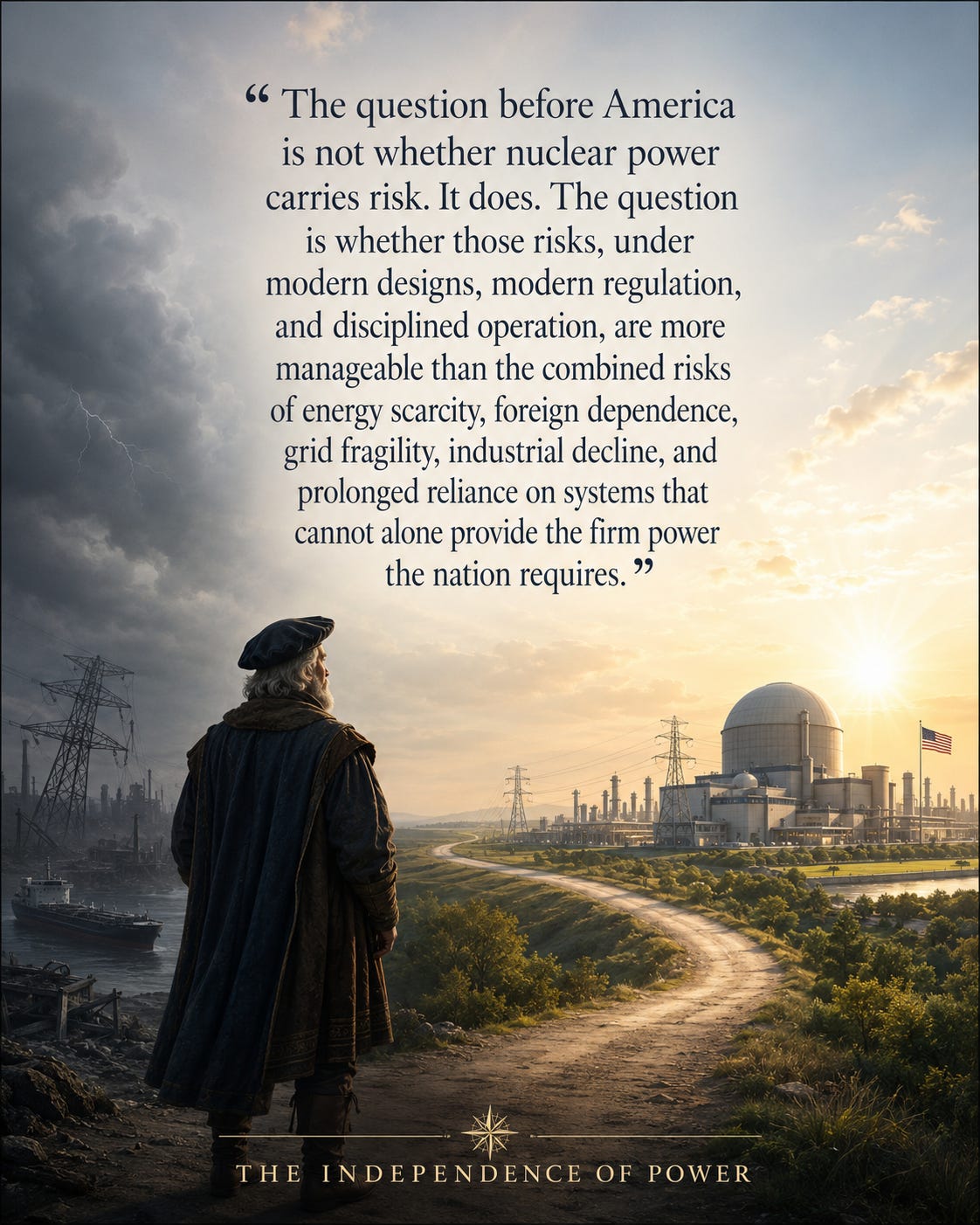
The question before America is not whether nuclear power carries risk. It does. The question is whether those risks, under modern designs, modern regulation, and disciplined operation, are more manageable than the combined risks of energy scarcity, foreign dependence, grid fragility, industrial decline, and prolonged reliance on systems that cannot alone provide the firm power the nation requires.
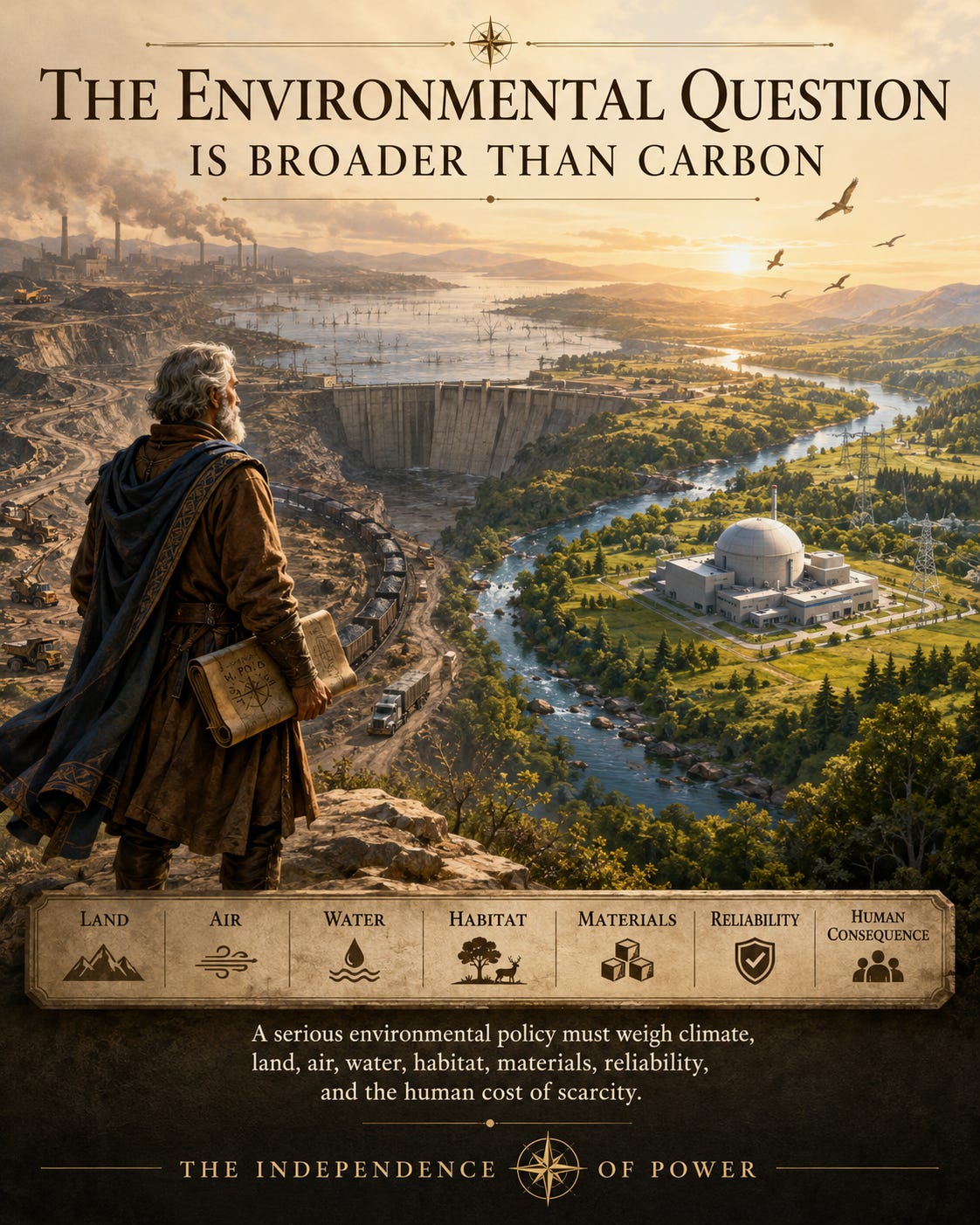
The Environmental Question Is Broader Than Carbon
The environmental history is more complicated than the public debate often suggests. In the early nuclear era, important conservationists and many leaders of the Sierra Club considered nuclear power potentially preferable to coal plants and large hydroelectric projects that would flood valleys, alter rivers, and destroy irreplaceable landscapes. The later fight over Diablo Canyon helped transform nuclear opposition into a defining environmental cause, but that position was not inevitable from the beginning.
That history is not useful as a “gotcha.” It is useful because it restores the older conservation questions: How much land must be occupied? How much fuel must be mined and transported? How much habitat is disturbed? How much material must be replaced? How much waste is produced, and can it be contained and accounted for? What form of power can support human prosperity while preserving the greatest amount of the natural world?
Nuclear power has an unusually strong answer because of energy density. A comparatively small site can produce immense quantities of electricity through winter and summer, day and night, with fuel inventories that can remain on site for long periods. Its normal operation produces no combustion emissions. Its material and waste streams are comparatively concentrated rather than dispersed continuously through the atmosphere.
This does not mean that mining, construction, cooling, decommissioning, and waste management disappear. They do not. It means they can be measured as part of a complete system rather than hidden outside the frame.
A serious environmental policy should care about climate, but also about land, air, water, habitat, materials, reliability, and the human consequences of expensive or unavailable energy. Nuclear power deserves consideration across that entire ledger.
Waste Is a Responsibility, Not a Disqualification
Spent nuclear fuel is highly radioactive and requires secure management over very long periods. That responsibility is real and cannot be wished away. The United States has also failed for decades to complete a durable political settlement for permanent disposal, even while technical work, storage, and regulatory oversight have continued.
But the existence of waste is not unique to nuclear energy. The distinction is that nuclear waste is physically limited, identifiable, guarded, monitored, and assigned to institutions with continuing responsibility. After cooling in pools, spent fuel can be sealed in steel canisters surrounded by additional steel or concrete. The NRC reports that dry-cask systems have safely stored spent fuel in the United States since 1986 without a radiation release that affected the public or contaminated the environment.
Interim storage is not a substitute for a permanent national policy. It does demonstrate that the material can be contained while that policy is completed. The proper response is stewardship: maintain safe storage, develop consolidated and permanent solutions, preserve technical capability, and refuse to treat political delay as proof that the physical problem cannot be managed.
Nuclear waste is a demanding obligation. It is also one of the few major energy wastes society insists on collecting rather than routinely dispersing.
Energy Independence Is National Independence
The reconsideration of nuclear power cannot be separated from national security. A country is not energy independent merely because resources exist beneath its soil. It must also possess the mines, conversion capacity, enrichment, fabrication, factories, qualified suppliers, skilled workers, transport systems, regulators, operators, and institutions needed to turn those resources into dependable power.
For too long, the United States allowed parts of that system to weaken or migrate abroad. That dependence affects more than utility planning. It touches defense installations, shipbuilding, advanced manufacturing, communications, artificial intelligence, water systems, hospitals, research laboratories, and every critical activity that assumes reliable electricity will be available when needed.
Nuclear fuel is compact and can support long operating cycles. Plants can maintain significant fuel inventories on site, reducing exposure to the continuous delivery constraints that affect some other forms of generation. A strong domestic nuclear system can also sustain high-skill employment, materials science, advanced manufacturing, national laboratories, naval capability, and a supplier base with value far beyond the power sector.
Energy abundance is therefore not simply an economic convenience. It is strategic capacity. A nation unable to power its own factories, military installations, laboratories, data infrastructure, and essential services on terms it can control is not fully sovereign.
Nuclear power will not provide every electron or solve every energy problem. It does offer a combination that is increasingly difficult to replace: firm, clean, compact, domestic power backed by fuel and machinery that can be secured for the long term.
Urgency Without Haste
A renewed nuclear commitment must not repeat the mistakes of either complacency or panic. America should not rush incomplete designs into construction, weaken independent regulation, dismiss local concerns, or allow schedule pressure to substitute for engineering discipline. Public confidence will be earned through transparency, competence, measurable performance, and a willingness to state clearly what is known, what remains uncertain, and who is responsible.
But seriousness cannot become an excuse for paralysis. Endless sequential review, shifting requirements, one-off designs, uncertain fuel policy, disappearing suppliers, and projects that never progress beyond announcement are not evidence of caution. They are evidence of a country losing the ability to act.
America should move with urgency, but not with haste. It should proceed expeditiously because the need is real, deliberately because the responsibility is great, and repeatedly because no industrial system can be rebuilt through isolated demonstrations.
This is the dawn of a new era: informed by the accidents, strengthened by the lessons, more capable in design, and more aware of the national stakes. The purpose is not to recreate the nuclear industry of the 1970s. It is to build the nuclear system the twenty-first century requires.
Now We Can Proceed
The argument for nuclear energy is not that it is perfect. The argument is that a prosperous, secure, industrially capable America needs large quantities of dependable power; that modern nuclear technology can provide an important share of it; and that its risks can be governed with engineering, regulation, operating discipline, transparency, and long-term stewardship.
The accidents must be remembered. The waste must be managed. The public must be protected. The supply chain must be rebuilt. Those obligations are not reasons to abandon the work. They are the conditions under which the work must be done.
With that understanding, we can turn cleanly to Chapter 4: The Nuclear Return: From Reactors to an Industrial System.
Source Notes
1. U.S. Nuclear Regulatory Commission, “Backgrounder on the Three Mile Island Accident.” Used for the partial core meltdown, the institutional and operating lessons, and the NRC finding that the small radioactive releases produced no detectable health effects among plant workers or the public.
2. World Health Organization and the Chernobyl Forum, “Chernobyl: The True Scale of the Accident,” 2005, and Chernobyl’s Legacy. Used for acute worker and responder deaths, the increase in thyroid cancer among those exposed at young ages, displacement, contamination, and the broader health and social record.
3. United Nations Scientific Committee on the Effects of Atomic Radiation, UNSCEAR 2020/2021 Fukushima Report and FAQ. Used for the finding that no adverse health effects among Fukushima residents have been documented that could be directly attributed to radiation exposure, and that such effects are not expected to be detectable in the future.
4. U.S. Nuclear Regulatory Commission, “Implications of Safety and Operational Features of Small Modular and Advanced Reactors,” 2025, and NRC advanced-reactor technical materials. Used for passive safety systems, natural circulation, reduced reliance on active components, design simplification, and inherent safety characteristics.
5. U.S. Nuclear Regulatory Commission, “Backgrounder on New Nuclear Plant Designs.” Used for the distinction between active and passive systems and for examples of systems that rely on gravity and other natural forces rather than electric-powered pumps.
6. U.S. Department of Energy, Office of Nuclear Energy, “TRISO Particles: The Most Robust Nuclear Fuel on Earth,” and “Nuclear 101: What Is a High-Temperature Gas Reactor?” Used for TRISO fuel construction, high-temperature tolerance, and the description of coated fuel particles as individualized containment systems.
7. U.S. Nuclear Regulatory Commission, “Dry Cask Storage” and “Backgrounder on Dry Cask Storage of Spent Nuclear Fuel.” Used for the construction and purpose of dry-cask systems and the U.S. operating record since the first casks were loaded in 1986.
8. High Country News, “The Divide Over Diablo,” September 13, 2022; and historical accounts of the Sierra Club’s Diablo Canyon debate. Used for the early conservation movement’s divided view of nuclear power, including support among some Sierra Club leaders who considered it preferable to coal development and large hydroelectric dams.
9. U.S. Department of Energy, Office of Nuclear Energy, Nuclear Energy overview and fuel-cycle materials. Used for nuclear power’s role in reliable low-carbon generation, national defense, domestic fuel capability, and the strategic importance of rebuilding the broader nuclear energy system.